The Effect of Swirl Flow on the Two-Stroke Boosted Uniflow Scavenged Direct Injection Combustion Engine (BUSDICE) under ultra-lean hydrogen conditions
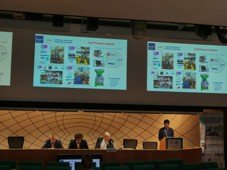
Dr. Yizhuo Feng represented our team at the 2026 Direct Injection 2-Stroke Engines International Conference Modena, Italy From:23/09/2026 to: 25/09/2026.(Conference/Paper Link).
Controlling in-cylinder mixture formation is essential for achieving efficient and low-emission combustion in ultra-lean hydrogen engines. This numerical study examines how scavenging-port orientation governs bulk-flow structure, fuel distribution, and combustion in a novel two-stroke boosted uniflow scavenged direct injection combustion engine (BUSDICE). Four scavenging-port angles (0° to 30°) were evaluated at 2000 rpm and an excess-air ratio of λ = 2.35. Increasing the port angle intensified swirl and weakened jet-induced tumble, shifting the flow from tumble-dominated to swirl-dominated flow. This transition affected mixture distribution and fuel stratification near the spark plug. The 20° design provided the richest local mixture and most favourable ignition conditions, whereas 30° configuration achieved the greatest overall mixture homogeneity. At maximum brake torque spark timing, the 0° and 30° configurations delivered comparable indicated thermal efficiencies, but 30° produced the lowest heat loss and reduced indicated specific NOX emissions to 0.63 g/kWh, providing the best efficiency-emissions balance.