Comparative Microscopic Visualization Study of Air Nanobubbles in Isooctane : Insight to Visualization Challenges
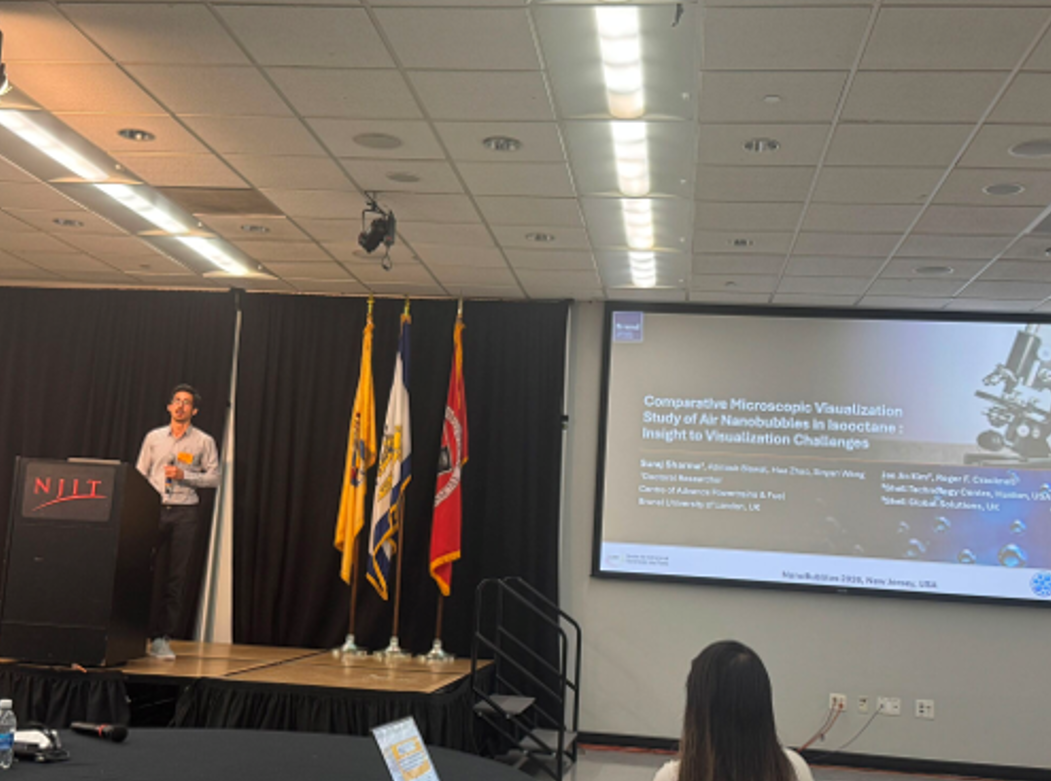
Suraj Prashad Sharma represented our team at New Jersey Institute of Technology, Newark, USA From: 19/08/2026 to: 21/08/2026.(Conference/Paper Link).
This study presents a comparative microscopic investigation focused on the visualization of air nanobubbles (ANBs) in isooctane, a key component of gasoline. ANBs were generated in isooctane using hydrodynamic cavitation, and their nanoscale presence was initially confirmed by dynamic light scattering (DLS) - giving size distribution from 30 –120 nm with concentration reaching up to 10E+10 ANB/mL. The primary objective was direct microscopic visualization using multiple imaging techniques. Conventional optical microscopy up to 1000× magnification was employed but failed to resolve distinct nanobubble features due to resolution limitations. Cryogenic microscopy was subsequently attempted to stabilize the volatile sample; however, rapid vaporization of isooctane restricted clear interpretation, yielding only indistinct particle-like features. In contrast, liquid-phase transmission electron microscopy (Liquid TEM)—that is, TEM imaging of liquid phase samples using a dedicated liquid holder—provided stable imaging conditions and enabled clear, direct visualization of ANBs in isooctane. The spherical nanoscale features observed in the TEM images, confirm the presence of nanobubbles in the nonpolar hydrocarbon medium. This study highlights the inherent challenges of imaging nanobubbles in volatile liquids and establishes Liquid TEM as an effective technique for their direct visualization.